
Curved Wall Cladding with Flexible Stone Panels
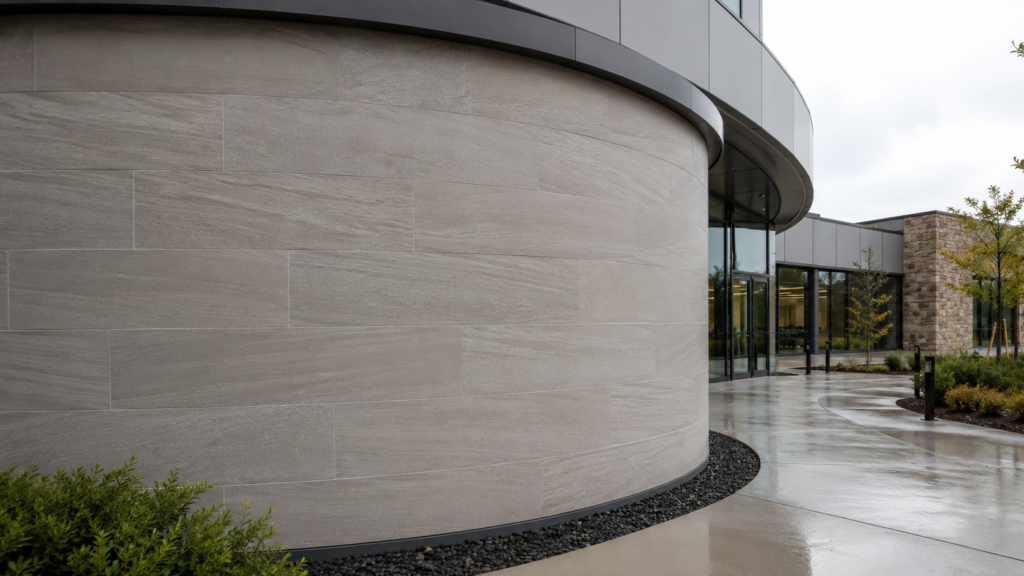
Curved wall cladding made from flexible stone bends around columns, radius walls, and archways as one continuous sheet — no cutting the surface into joint-matched segments to follow the curve.
Rigid stone veneer and cast rock panels must be cut and pieced together around curves, creating visible joints. Flexible stone is a thin soft porcelain (MCM) sheet that conforms to curved or irregular surfaces within the specified bend radius, creating a more continuous finish.
For exterior use, freeze-thaw performance is manufacturer-reported and depends on the selected model and installation system. The soft porcelain material uses a thin, water-based inorganic body that allows a single sheet to flex around curves. See flexible stone panels for the wider product line.
| Attribute | Spec |
|---|---|
| Minimum convex radius | Not a fixed catalog figure — confirmed against substrate shape and panel size at quote stage |
| Minimum concave radius | Not a fixed catalog figure — confirmed against substrate shape and panel size at quote stage |
| Sheet thickness | Confirmed per order, not a published fixed spec |
| Sheet sizes available | 1200×2400 mm / 1200×3000 mm / 600×1200 mm / 600×2400 mm / 600×3000 mm |
| Panel weight | Confirmed per order, not a published fixed spec |
| Fire performance | Product- and assembly-specific; request the applicable report and classification |
Curved applications generally fall into a few categories:
a curved accent wall behind a sofa, bed, or reception counter
full wraparound coverage with no vertical seam break
curved fronts in hotels, offices, and retail
following the transition from wall to opening
Decorative curved wall cladding in a living room typically uses a soft stone or travertine finish on an interior-grade substrate. Interior stone wall panels covers indoor substrate and fire-behavior details.
Exterior curves on building corners or planter walls need a weather-rated substrate underneath. Exterior stone wall panels covers outdoor substrate requirements.
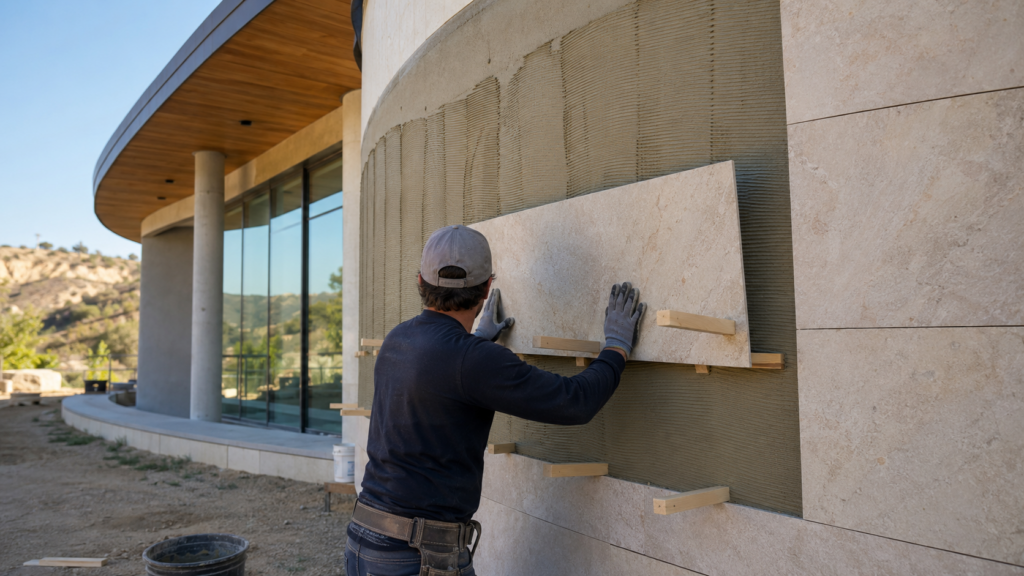
The curve must be formed in the substrate before installation, using curved OSB, calcium-silicate board, or a shaped cement layer built to the target radius. Framing and finishing this substrate adds labor and cost compared with a flat wall.
Once the substrate is ready, the flexible stone sheet is adhered directly to it and temporarily held with wood blocks or gas nails while the adhesive sets. The panel does not need to be cut into jointed segments to follow the curve.
gives a matte, riven finish
gives a warmer, granular finish
gives a classic veined look
covers the broader catalog of surface patterns
Curved runs work with the same finish options used on flat walls, since the surface pattern is carried in the sheet itself rather than cut from quarried stock. That inkjet-printed surface has less texture depth and natural pitting than real riven or tumbled stone — the trade-off for a material that bends where solid stone can't.

Angtai adheres flexible stone directly to shaped OSB, calcium-silicate board, cement wall, or concrete slab using adhesive applied to the panel back. The installation guide explains surface prep and adhesive application step by step.
Order quantities are confirmed during quote review. Production and delivery typically take 25–30 days, while free samples ship within 5 days after price confirmation. Quotes return within 24 hours, and OEM/ODM support covers custom sizing for radius projects. Contact us with your curve dimensions to request a sample and quote.
