By Jimmy
 21 Aug, 2026
 12 Minutes Read
Exterior stone panels replicate the look of quarried stone on a building’s facade without the weight, cost, or structural work of full masonry construction. Instead of stacking individual stones with mortar, a panel system covers a wall in larger, pre-formed sections that go up faster and put less load on the substrate. Four material types cover nearly everything sold as “stone panels” today — natural stone veneer, cement-based cultured stone, polyurethane/PVC faux stone, and flexible stone (soft porcelain/MCM) — and picking the wrong one for a given wall type or climate is the most common reason installations crack, delaminate, or get torn out early.
“Exterior stone panels” is an umbrella term. It covers anything manufactured or engineered to give a wall the visual texture, color variation, and depth of natural stone — whether that product is quarried stone sliced thin, molded cement, foamed polyurethane, or a printed ceramic-based surface bonded to a flexible backing. What they share is a goal of cladding a building envelope with stone-like character while reducing at least one of three burdens that full-depth masonry carries: weight, labor cost, or installation time. Which burden gets reduced — and by how much — depends entirely on which of the four material types is in play. exterior stone wall panels lists the specific product sizes and finishes available in the flexible stone category.
This guide compares the four main exterior stone-panel material families and the checks that affect installation and buying decisions; for Angtai product sizes, samples or quotations, use the exterior stone wall panels page.
Not all “stone panels” are the same product, and mixing up the categories is the fastest way to buy the wrong one.
Natural stone veneer is real quarried stone, cut thin (typically an inch or less) to reduce weight versus full-bed stone. It’s the most authentic option in color, texture, and long-term weathering behavior, but it’s also the heaviest of the four categories and usually needs mechanical anchoring or a mortar setting bed rather than simple adhesive. Granite veneer typically costs more than sandstone or limestone because of quarrying difficulty, and heavier cuts need additional wall bracing that adds labor cost on top of the material price. thin stone veneer cost guide breaks pricing down by stone type and cut thickness, and thin stone veneer alternatives sets it directly against the other three categories on weight, install method, and durability.
Among quarried veneer types, sandstone is prized for a warm, granular texture and softer face than slate or limestone, though its higher porosity means many installations need periodic sealing in freeze-thaw climates. The sandstone veneer panels guide walks through its quarrying and cut profile, and sandstone veneer panels pros and cons weighs that sealing upkeep against its lower cost relative to granite or marble veneer.
Cultured stone is molded from a lightweight cement-and-aggregate mix, cast in forms taken from real stone to replicate its texture. It’s lighter than full-depth veneer and can be panel-mounted with embedded flanges for a mortar-less installation, which is why it’s popular with DIY renovators. The trade-off is that it’s still a rigid, cement-based product — it doesn’t flex to follow curved walls, and like any cementitious cladding it depends on a sound moisture barrier behind it to avoid trapped water.
Faux stone panels are molded from high-density polyurethane or PVC. They’re the lightest of the traditional three options, easy to cut with basic tools, and generally installed with screws and construction adhesive over sheathing. The lighter weight comes with a lighter-duty feel and less dimensional depth than cement or natural stone, and most manufacturers don’t recommend mounting them directly to unsupported vinyl siding, since that substrate flexes with temperature.
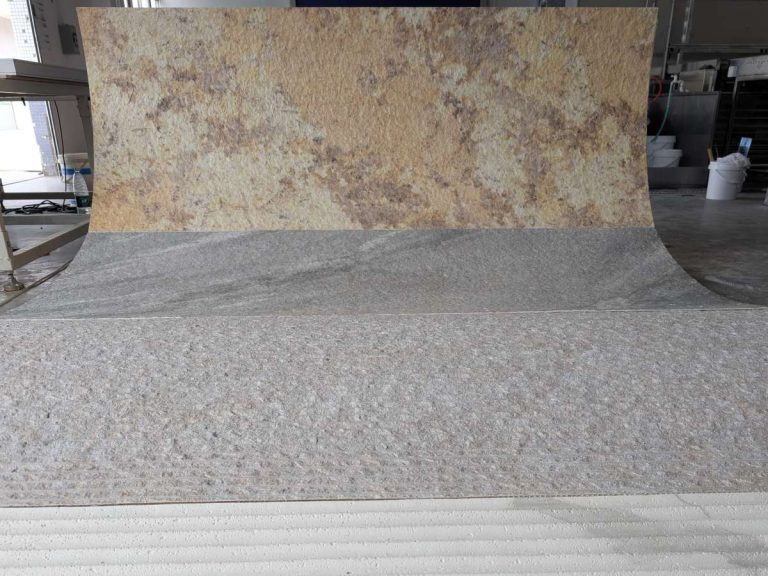
Flexible stone — also called soft porcelain or modified clay material (MCM) — is a firing-free inorganic ink printed onto a thin, bendable backing, engineered to reproduce stone’s look and texture while behaving more like a heavy-duty wallcovering than a masonry product. Because the sheet flexes, it can conform to columns, curved facades, and irregular surfaces within the specified bend radius, and because it’s thin it adds far less dead load to a wall than natural veneer or cultured stone. It’s applied by direct adhesive bonding rather than mortar, which is why it shows up on retrofits over existing tile as often as new builds. Its downsides are the flip side of that thinness: it depends entirely on correct substrate prep and adhesive bond rather than mechanical anchoring, and as a comparatively newer category it doesn’t carry the decades-long field record that quarried stone does. Flexible stone wall panel pros and cons weighs those trade-offs against cement, faux, and natural options in more depth.
There’s no single “best” fake stone — the right pick depends on how much weight your wall can carry, what substrate you’re starting from, and how much of the job is DIY versus professional.
| Material Type | Relative Weight | Relative Cost Tier | Typical Substrate | Best-Fit Use Case |
|---|---|---|---|---|
| Natural stone veneer | Heaviest | Highest (varies by stone type) | Mortar/mechanical anchor over structural sheathing | Ground-level facades where authentic stone composition matters |
| Cultured/cement stone | Moderate | Mid-range | Plywood/OSB, panel clips or mortar bed | Masonry look with mortar-less DIY installation |
| Faux polyurethane/PVC | Very light | Lowest material cost | Wood sheathing, furred concrete/brick | Fast accent walls, renovations with strict load limits |
| Flexible stone / soft porcelain (MCM) | Light, thin profile | Variable — scales with pattern complexity and panel size | Concrete, cement board, OSB, existing tile, metal panel | Curved surfaces, high-rise facades, retrofits over existing finishes |
Weight class and substrate compatibility should narrow the field before cost enters the conversation — a rigid panel that needs furring and mechanical anchors adds labor cost regardless of the material’s base price.
Installation mechanics shift by material, but the broad sequence — and the reasons it can go wrong — are consistent across the category.
Most exterior stone panel types can go over concrete slab, cement wall, cement board, OSB, or plate metal, and several also bond to aluminum-plastic composite panel or calcium-silicon board. Flexible stone can additionally adhere directly to existing ceramic tile that’s firmly attached, which matters on renovation jobs where tearing out old tile isn’t practical. Whatever the substrate, it has to be level, clean, dry, and free of dust, oil, or loose particles before anything goes on it.

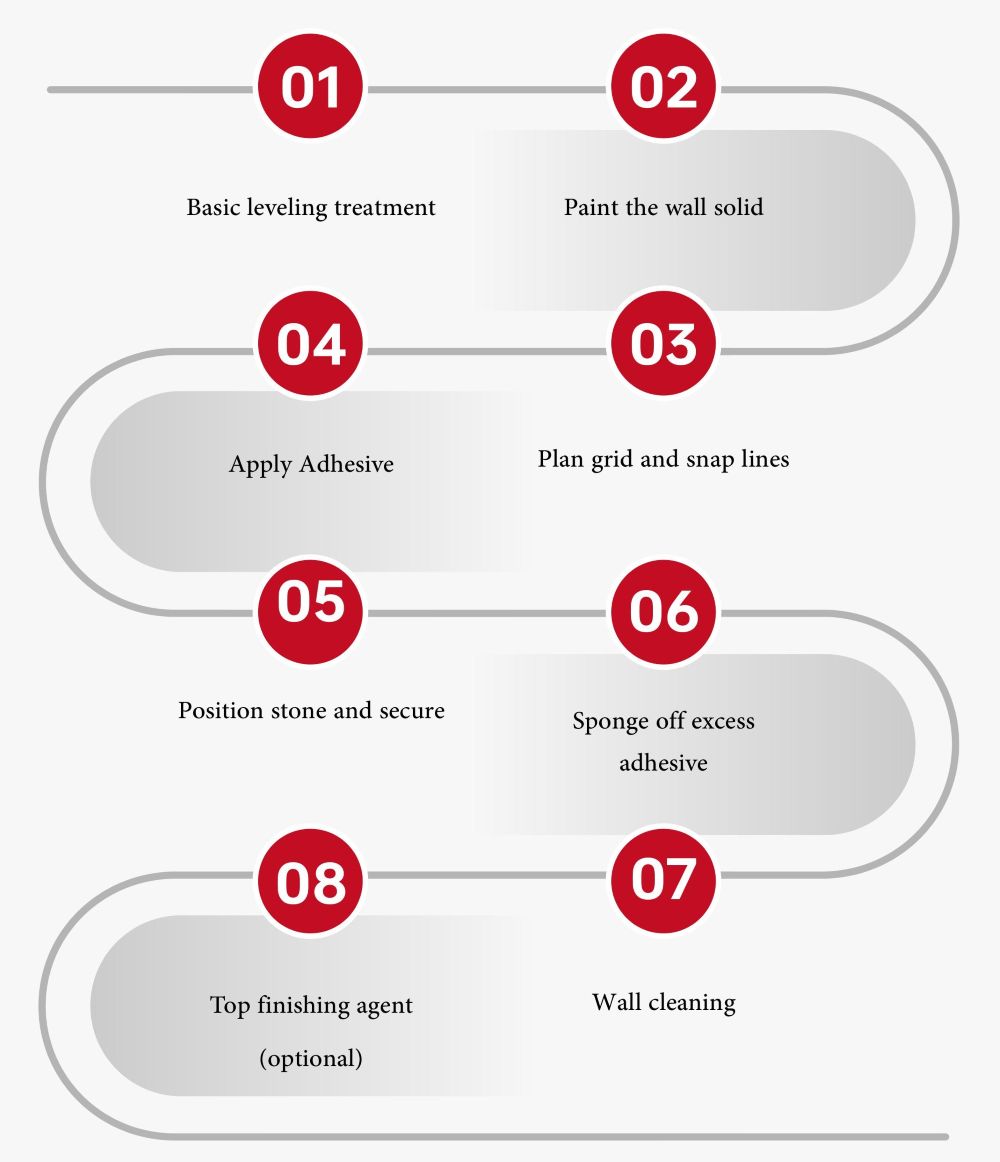
Across material types, the sequence runs: prep the surface (clean, dry, coat with an interface agent on smooth walls to improve adhesion) → lay out the pattern with level lines → attach or adhere each panel starting from a stable base point → cut and fit around edges, corners, and openings → finish seams and clean off adhesive residue before it cures. For flexible stone specifically, panels bond with adhesive applied to the panel back, get pressed onto the base, held temporarily with wood blocks or gas nails while the bond sets, then get trimmed with a blade and wiped clean. The flexible stone installation guide shows the full base-layer buildup, including the interface-agent coat and bonding film pictured below.

Cement-based and mortar-set products are the most weather-sensitive to install, since mortar cure times and bond strength suffer in freezing or persistently wet conditions. Adhesive-set panels, including flexible stone, are less dependent on ambient cure chemistry but still need a dry, frost-free substrate — installing over damp or frozen sheathing traps moisture regardless of which panel type goes on top. Where a design calls for a drained and vented air gap behind the cladding rather than direct adhesion, the assembly follows rainscreen principles instead of direct bonding, covered in the rainscreen system guide.
These are the technical mistakes that cause actual installation failures, separate from picking a style that clashes with the house:
Behind almost any exterior stone panel, you need a sound, weather-resistant barrier between the panel and the structural wall — house wrap or a comparable membrane on wood-framed walls, with flashing detailed around windows and doors so water can’t get behind the cladding. Depending on the material, that barrier sits under furring strips (for panels that need an air gap) or under a direct-adhere interface layer (as with flexible stone bonded straight to a prepped substrate).
Once installed, exterior stone panels generally need only periodic rinsing and a visual inspection for seam separation or cracked units — there’s no universal recoating schedule across material types, since cement, polyurethane, and flexible stone weather differently. Request the applicable reports, methods and model scope; installed performance also depends on the substrate, adhesive, seams and exposure.
Cost differences across the four categories track weight and labor complexity as much as raw material price. Natural stone veneer sits at the top of the cost range because quarrying, cutting, and the bracing heavier cuts require add labor on top of material cost. Cultured stone runs mid-range — its mortar-less flange-mount system trims labor without cutting material cost much. Faux polyurethane panels usually carry the lowest material cost but the least durability under sustained direct sun. Flexible stone’s cost is more variable, scaling with pattern complexity and panel size rather than a flat per-square-foot rate — Angtai ships flexible stone tiles ranging from 600×1200 mm up to 1200×3000 mm, ordered through a quote-and-sample process rather than off-the-shelf retail pricing.
A quotation response is typically issued within one business day after complete project details are received, free samples ship after price confirmation (with the customer covering courier cost), and production typically takes about 25–30 days after order confirmation; international transit time is additional and destination-dependent, paid via T/T or L/C. Exterior stone panels cost by material type breaks down what drives price differences across all four categories in more detail.
Run through this checklist before ordering:
Once a direction is narrowed down, exterior stone wall panels lists the specific sizes, finishes, and substrate compatibility for flexible stone. For interior applications, interior stone wall panels pros and cons covers how the same material performs indoors. For project-specific pricing and sample availability, send the project details.

How do you install exterior stone veneer panels?
Real stone veneer is heavy, so it usually needs mortar or mechanical anchoring into structural sheathing or block. Lighter manufactured stone, faux polyurethane, and flexible stone rely on adhesive or screw-mounted flanges instead. Surface prep, layout, and seam finishing apply across all of them.
What is the most popular stone for home exterior?
Popularity varies by region and architectural style, from traditional fieldstone and ledgestone looks to slate and travertine textures. Rather than one universal choice, match the stone’s texture and undertone to your home’s existing siding, roofing, and trim colors for a cohesive result.
What are the downsides of stone cladding?
Downsides include added structural weight (for natural and cultured stone), the need for a properly detailed moisture barrier to avoid trapped water, higher cost for authentic materials, and the risk of a mismatched scale or style if samples aren’t tested against the actual building before a full order is placed.
What do you put behind stone veneer?
Behind stone veneer sits a weather-resistant barrier such as house wrap, with flashing at windows and doors to direct water away from the wall assembly. Depending on the panel type, furring strips may create a drainage gap, or the panel may bond directly to a prepped, interface-agent-coated substrate.
What is the best fake stone for exterior use?
There’s no single winner — it depends on wall load capacity, surface shape, and install method. Faux polyurethane suits lightweight DIY accent walls; cultured stone suits mortar-less masonry looks; flexible stone/soft porcelain suits curved surfaces, high-rise facades, and retrofits where minimal added weight matters most.
Does installation differ across concrete, brick, and wood walls?
Wood sheathing generally accepts direct screw-and-adhesive mounting. Brick and concrete often need furring strips to create a flat, even base for rigid faux or cultured stone panels, plus masonry anchors. Flexible stone typically skips furring on concrete or cement board, bonding directly to a clean, level surface with adhesive alone.
 Guidelines
 Guidelines
 Guidelines
 Guidelines
 Guidelines
 Guidelines